
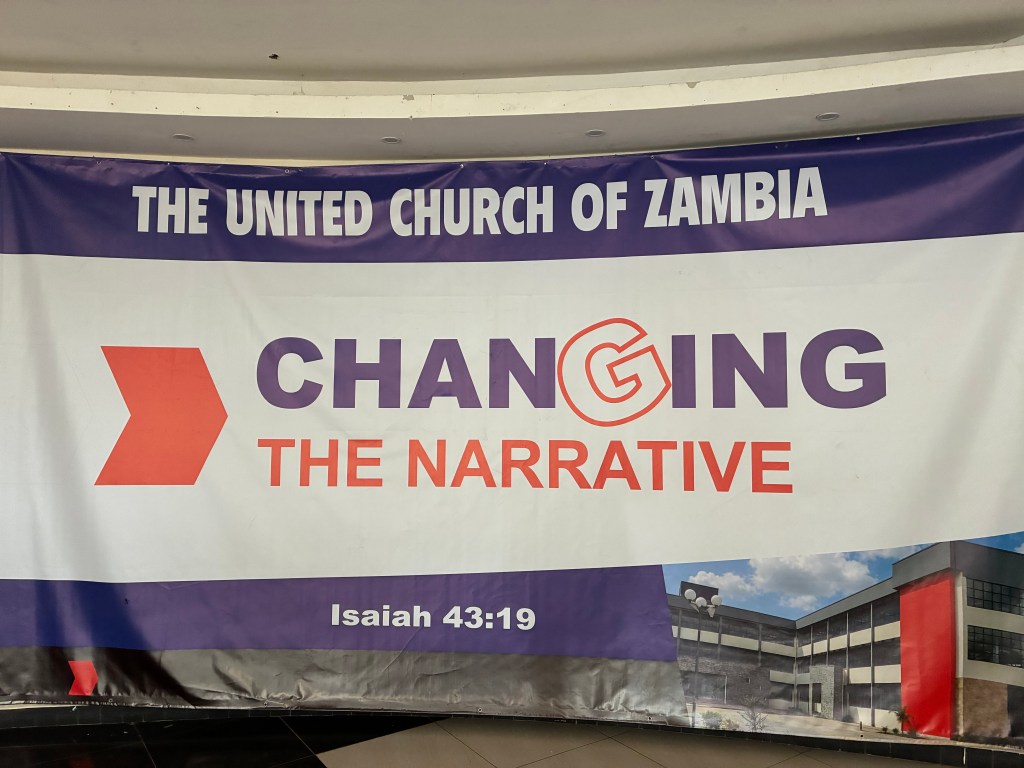
It was a great joy for me to join with the United Church of Zambia for a week of prayer and discussion about its future direction. It is a Church that stands out in Africa because in 1965 it achieved the unity of which many could do no more than dream. It brought together Congregationalists, Methodists, the Paris Evangelical Missionary Society and the Church of Scotland to form a genuinely nationwide church, with a substantial presence in every province.
Zambia had gained its independence the previous year, in October 1964, with its energetic young President Kenneth Kaunda seeking to unite a vast and ethnically diverse territory with his slogan of “One Zambia, one nation.” The UCZ struck a similar note with its motto “All One in Christ.” At last week’s convention, an Anglican observer described the UCZ as “the church that looks after Zambia.” Though not having any formal status, it functions to some extent as a national church.
The growth of the Church has been prodigious. In 1986 it estimated that it had 150,000 members and 64 full-time paid ministers. By 2023, it had more than 3,000,000 members, organised in 1,224 congregations, with 486 ministers. It has evolved its own system of government, essentially Presbyterian but with a (term-limited) Bishop as chair of each Presbytery and a Synod Bishop as the spiritual leader of the whole Church.
It combines a vibrant evangelical spirituality with an inclusive openness that respects diversity. Its worship incorporates elements of Pentecostal spirituality in a moderate way, guarding against extremes. It somehow manages be both “folk church” and “free church” – expressions which in Europe have often been polarised. Its life and witness no longer depend on external support, it is comfortable in its own skin, and it has the confidence to chart its forward direction.
If this is Christianity’s “African century,” the UCZ can be expected to have a significant role to play.

