
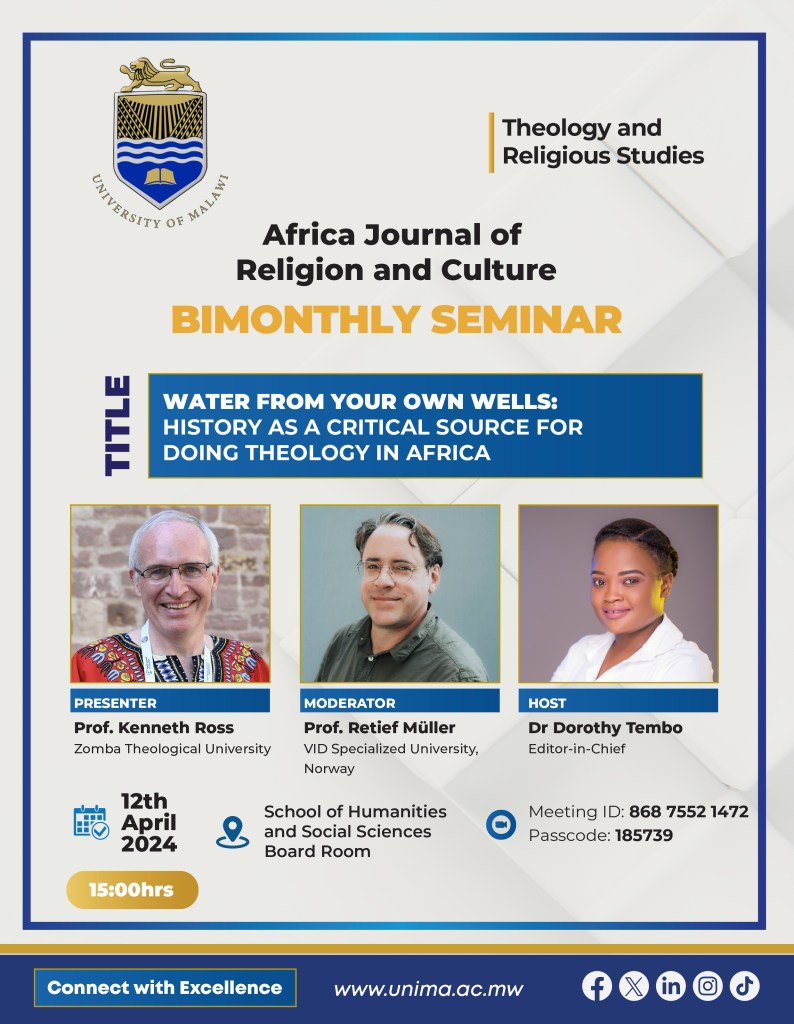
A new development this year is that the Department of Theology and Religious Studies at the University of Malawi is launching a new journal – the Africa Journal of Religion and Culture. Actually, it is a relaunch of an old journal Religion in Malawi in which I was much involved when I was a member of the Department in the 1990s.
As a seedbed for the new journal, the Department is running a bimonthly seminar series that seeks to connect Malawian scholars with the international academic community. Yesterday it was my turn to present, so I found myself in the Senior Common Room of my old College – a nostalgic experience since we held dozens of seminars there during eventful times in the ‘90s.
It gave me a chance to return to a question that has remained with me since those days: what part can history play in the construction of African Christian theology? At the academic level, African Christian theology is still relatively young. It was quite late in the twentieth century before it really took off. It has been exciting to see it taking shape.
Its great preoccupation has been with the relation between faith and culture. This has been driven by the identity crisis experienced by many Africans who became Christians but remained uneasy about the apparent foreignness of their faith. The big question is about how you can be both genuinely Christian and authentically African. Or, as John Gatu of Kenya put it, “joyfully Christian and truly African.” Hence I very much appreciate the need for attention to the faith and culture question.
But my argument yesterday was that it also has its limitations, especially as time goes on and African societies are beset by various crises. My proposal is that there is need to attend also to history – the specific history of African Christian communities. Many of them have discovered and tested the meaning of their faith by going through struggles and crises. Reflecting on this experience across the past 150 years yields a lot of material that can inform theological construction. To be equipped to meet the crises of the future, I propose that theologians need to pay more attention to history. I must admit that this is an old hobby horse, but it enjoyed its outing in a new paddock.
 Thinking Mission Blog